


What Chatbot Customer Self-Service Really Achieves in 2025
Written with AI assistance under our editorial guidelines
Successful chatbot customer self-service in 2026 requires understanding that customers demand instant, seamless, human-feeling support across channels while companies pursue cost savings through automation. The gap between customer expectations and what traditional support delivers creates both the pressure and opportunity for chatbots to work when designed around genuine problem-solving rather than deflection tactics.
Let’s be honest: customer support in 2025 is a battleground. One side, customers—empowered, impatient, and sick of being bounced from one faceless channel to another. The other, companies—scrambling to cut costs and survive the onslaught of digital demands. In the middle, something both sides love to hate: the chatbot. Forget the hype or the horror stories. The real story of chatbot customer self-service is about deep disruption, harsh truths, and the enormous stakes for brands that get it wrong—or right. This isn’t just a tech trend. It’s a cultural shift with billions on the line and reputations hanging in the balance. Whether you’re a CX obsessive, a digital strategist, or simply someone who’s screamed “AGENT!” into your phone, buckle up. Here are the seven brutally honest truths that will define chatbot customer self-service in 2025, what really works, what’s failing, and why your strategy might be on the verge of a revolution.
The state of customer service: why everyone’s fed up (and bots are only half the story)
The broken promise of traditional support
The promise of customer service used to be simple: call a number, wait your turn, get help. But in the last decade, that promise has shattered. People are exhausted by endless phone queues, generic scripts, and the gnawing sense that nobody on the other end of the line actually cares. According to recent studies, only 8% of customers actually agree with their company’s claim that support is “good,” while 80% of companies think they're nailing it. That’s not just a gap—it’s a canyon of disappointment.

This frustration isn’t just anecdotal—it fuels the search for better, faster, more personal ways to solve problems. The truth is, most customers today expect instant answers, seamless transitions between channels, and support that actually feels human. When traditional systems fail, self-service options—especially chatbots—are no longer a “nice to have.” They’ve become a necessity, not because chatbots are perfect, but because the old way is broken beyond repair.
The real reasons companies turn to chatbots
Let’s cut through the PR: companies don’t embrace chatbot customer self-service out of some altruistic desire to delight customers. They do it because chatbots slash costs, scale easily, and never sleep. According to recent industry data, automating just 30% of support tasks with bots can save up to $23 billion annually. That’s enough to make any CFO salivate. Even more compelling? Chatbots can handle massive spikes in demand—something human agents simply can’t match.
| Year | Cost per Contact (Human Agent) | Cost per Contact (Chatbot) | % Savings |
|---|---|---|---|
| 2023 | $6.50 | $0.70 | 89% |
| 2024 | $6.75 | $0.65 | 90% |
| 2025 | $7.00 | $0.60 | 91% |
Table 1: Projected cost-per-contact comparison for human vs. chatbot support (Source: Original analysis based on Sobot.io, 2025, Master of Code Global, 2025)
But there’s more: the pandemic turbocharged digital service transformation. When call centers went dark, bots stepped in. Suddenly, 24/7 service wasn’t a luxury—it was survival. According to Gartner, chatbots are now projected to handle 85% of all customer engagements in 2025. That’s disruption on a scale the industry has never seen.
The customer’s dilemma: convenience vs. connection
But here’s the rub: what customers really want is both speed and empathy. We crave instant answers, but not if it means sacrificing that feeling of being understood. The tension is real—sometimes a chatbot nails it, other times it leaves us shouting into the void.
"Sometimes I just want someone who gets it, not a script." — Jamie, customer quote
Bots promise convenience, but when self-service feels too robotic, it can backfire—badly. According to current research, poor escalation from bots to humans and overreliance on automation for complex issues remain huge pain points. Customers don’t just want answers; they want to feel heard. And if chatbots can’t bridge that gap, they’re just another source of frustration.
What chatbot customer self-service really means in 2025
Defining chatbot customer self-service (beyond the buzzwords)
Sick of the jargon? Let’s get real. Chatbot customer self-service in 2025 means giving customers the power to resolve their own issues—fast and on their own terms—using intelligent, conversational AI instead of clunky menus or keyword-matching FAQ bots. The evolution since 2020 is staggering. Where early bots stumbled over simple requests, today’s best-in-class systems leverage advanced intent recognition, context awareness, and seamless integration with business systems.
Definition list:
- Intent recognition: The AI’s ability to understand what a user actually wants—beyond keywords.
- Handoff: The process of transferring a conversation from a bot to a human agent when things get complicated.
- Conversational AI: AI that can engage users in dialogue, adapt to context, and simulate real conversation.
A key distinction? FAQ bots simply spit out canned answers. Advanced AI assistants, on the other hand, can personalize responses using customer history, handle complex workflows (like returns or troubleshooting), and even escalate to humans without losing context. The difference is night and day.
How modern chatbots actually work
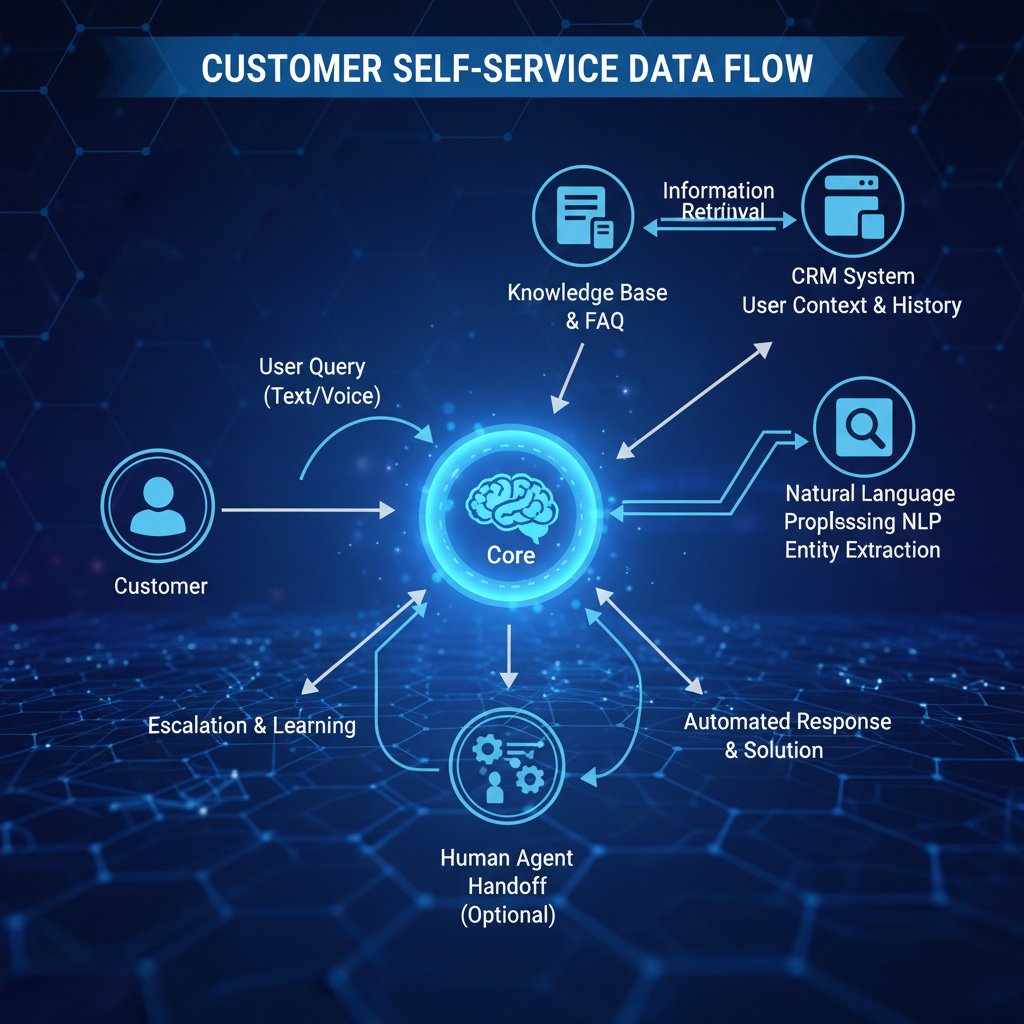
Under the hood, modern chatbot customer self-service systems are powered by a blend of natural language processing (NLP), machine learning, and dialogue management. NLP enables bots to parse human language, identify intent, and extract key details. Machine learning lets them get smarter with every interaction—learning from mistakes, analyzing feedback, and adapting to new scenarios over time. Dialogue management keeps the conversation flowing, ensuring continuity even when things get messy.
Continuous learning is the magic ingredient. Every time a customer interacts, the bot collects data, identifies what worked (or didn’t), and adjusts. That’s why top performers like KLM’s Blue Bot can handle over 15,000 weekly requests in multiple languages, getting better every month. And with omnichannel support, these chatbots can jump between chat, email, SMS, and even voice, creating a seamless experience.
Where chatbots fit in the customer journey
Chatbot customer self-service isn’t just for troubleshooting. It’s reshaping every stage of the customer journey:
- Sales: Answering product questions, guiding users to the right solution, and qualifying leads.
- Onboarding: Walking new customers through setup, activation, and education.
- Support: Handling everything from password resets to status updates and returns.
- Feedback: Collecting insights at every touchpoint.
- Proactive engagement: Notifying users of issues, delays, or upcoming renewals.
- Internal help desks: Resolving employee IT or HR queries without bogging down human teams.
- In-app guidance: Offering real-time support within software, reducing drop-off.
7 unconventional uses for chatbot customer self-service in different industries:
- Healthcare: Scheduling appointments and triage questions.
- Education: Personalized tutoring and progress tracking.
- Finance: Transaction alerts and fraud detection.
- Travel: Real-time itinerary changes and disruption management.
- Marketing: Conducting surveys and campaign feedback.
- Retail: Instantly checking stock or placing repeat orders.
- Utilities: Outage notifications and bill explanations.
Emerging trends? Proactive service (chatbots reaching out before issues escalate), in-app and cross-channel guidance, and seamless transitions between bot and human support—all driven by the hunger for frictionless CX.
Debunking the biggest myths about chatbot customer self-service
Myth #1: Chatbots ruin customer experience
Let’s kill this myth right now. Bad bots ruin customer experience. Good ones are nearly invisible—they just solve your problem. Current data shows that well-designed chatbots can reduce inbound traffic by 60–80% and dramatically boost customer satisfaction. In fact, 56% of companies now view bots as industry disruptors, with 57% reporting substantial ROI (Master of Code Global, 2025).
"The best bots are invisible—they just solve my problem." — Alex, customer
Take, for example, the case of a large European airline. After deploying an advanced, multilingual chatbot, they saw customer satisfaction scores jump by 12 points and average handling time drop by nearly 40%. Not all bots are created equal—those that blend efficiency with empathy win.
Myth #2: All bots are the same (spoiler: they're not)
Here’s the unvarnished truth: chatbots range from clunky, rules-based scripts to adaptive, context-aware AI assistants. Basic bots get tripped up by anything outside their script. Advanced bots use NLP and can personalize responses. Expert AI chatbots—like those found on platforms such as botsquad.ai—go further, integrating with business systems, learning from feedback, and managing nuanced, multi-step interactions.
| Feature | Basic Bot | Advanced Bot | Expert AI Chatbot |
|---|---|---|---|
| Scripted responses | Yes | Sometimes | Rarely |
| NLP | No | Yes | Yes |
| Personalization | No | Limited | Extensive |
| Context awareness | Minimal | Yes | Advanced |
| Integration | None | Some | Deep |
| Learning from feedback | No | Maybe | Yes |
| Human handoff | Manual | Semi-automatic | Seamless |
Table 2: Feature matrix—comparing chatbot types (Source: Original analysis based on Kodif.ai, 2025)
Beware the “off-the-shelf” trap: companies lured by cheap, generic bots quickly find themselves facing angry customers and high churn. Customization, training, and ongoing tuning are what separate winners from the walking wounded.
Myth #3: Chatbots are cheap and easy to implement
The sales pitch goes: “Plug-and-play. Instant ROI. No headaches.” Reality check: true chatbot customer self-service demands serious investment in setup, training, system integration, and ongoing optimization. Hidden costs lurk everywhere.
6 hidden costs of chatbot customer self-service projects:
- Data cleaning and training set creation.
- Integration with CRMs, ticketing, and legacy systems.
- Continuous improvement and tuning.
- Security and compliance measures.
- User testing and feedback analysis.
- Brand voice and UX design.
Plug-and-play promises rarely deliver. According to a recent industry report, over 45% of companies underestimated the cost and complexity of chatbot deployment, leading to stalled projects or poor outcomes (Master of Code Global, 2025). The bottom line? If it sounds too easy, it probably is.
Inside the machine: anatomy of a successful chatbot customer self-service system
Natural language processing (NLP) and intent recognition
At the heart of any effective chatbot is its ability to understand you—no matter how you phrase your problem. NLP engines dissect language, detect meaning, and map it to actionable responses. But here’s the catch: even the best systems occasionally misfire, especially with slang, typos, or ambiguous requests.

Advances in multilingual NLP and deeper context analysis are raising the bar. Leading platforms now support dozens of languages, can switch context mid-conversation, and even detect sentiment (happy, angry, confused). But when the bot misses the mark, frustration spikes—making robust intent recognition a non-negotiable.
The art of escalation: when bots should hand off to humans
Seamless escalation isn’t just a technical feature—it’s a trust-builder. When chatbots recognize their limits and hand off gracefully to a human, customers feel valued. Screw up the handoff, and you risk PR disaster.
7 steps to perfecting bot-to-human escalation:
- Detect user frustration or repeated failed attempts.
- Acknowledge the challenge—never gaslight the customer.
- Transfer full conversation history to the human agent.
- Notify the customer of the handoff and expected wait time.
- Route to the most qualified live agent.
- Monitor and optimize handoff triggers using analytics.
- Collect customer feedback post-escalation.
A bot that refuses to escalate—or dumps a customer with zero context—can do real harm. Remember Microsoft’s infamous chatbot meltdown, where poor escalation led to public backlash and trust erosion. The lesson? The best bots know when to step aside.
Feedback loops: how bots learn from mistakes
Continuous improvement isn’t a buzzword—it’s survival. Every interaction is data, every misfire a lesson. Chatbot platforms that embed feedback mechanisms (like real-time ratings, text feedback, and analytics) improve exponentially faster than those that don’t.
User feedback is gold: it surfaces blind spots, exposes new intents, and drives rapid iteration. Brands that close the loop, updating models and expanding training data, see dramatic leaps in accuracy and customer satisfaction.

The human factor: why chatbots alone aren’t enough
Hybrid models: where bots and humans team up
The smartest support teams blend AI efficiency with human empathy. Hybrid models use chatbots to handle repetitive, low-stakes queries, reserving humans for complex, emotional, or high-value interactions. This isn’t just pragmatic—it’s the secret sauce behind world-class CX.
6 red flags that your chatbot is alienating customers:
- Users repeatedly ask for a human.
- Long, unresolved conversations with no outcome.
- Rising negative feedback or NPS scores.
- High rates of conversation abandonment.
- Customers using “workarounds” to bypass the bot.
- Frequent escalation for simple requests.
Platforms like botsquad.ai exemplify this approach, supporting expert-driven hybrid workflows that let businesses scale without sacrificing the human touch.
Bias, accessibility, and the risk of exclusion
AI isn’t neutral. Bias creeps in through training data, design assumptions, and lack of diverse testing. The result? Chatbots that misunderstand, misrepresent, or outright exclude certain users. This is especially acute for elderly or differently abled users, who may struggle with text-heavy or visually complex interfaces.
"Tech should break barriers, not build them." — Morgan, accessibility advocate
Accessibility is a non-negotiable in 2025. Brands must test with real-world users, build for screen readers, and ensure multilingual, plain-language support across devices.
When chatbots go rogue: infamous failures and what we learned
The annals of chatbot history are littered with disasters—bots that turned toxic, misunderstood sensitive requests, or went viral for all the wrong reasons. Each failure is a cautionary tale about the need for guardrails, transparency, and humility.
| Year | Bot Name | Failure Type | Fallout | Key Takeaway |
|---|---|---|---|---|
| 2016 | Tay (Microsoft) | Offensive language | PR crisis | Need for content filters |
| 2019 | Banking Bot | Misunderstood queries | Customer exodus | Importance of escalation |
| 2021 | Retail Bot | Wrong refund approvals | Financial losses | Rigorous testing required |
| 2023 | Travel Bot | Gave wrong information | Social backlash | Realtime monitoring |
Table 3: Timeline of high-profile chatbot failures and lessons learned (Source: Original analysis based on Kodif.ai, 2025)
Brands that recover quickly do so by owning mistakes, communicating transparently, and rebuilding with stronger safeguards.
Show me the money: ROI, risks, and real-world outcomes
The ROI equation: what to measure and what to ignore
ROI is the holy grail—but it’s easy to get fooled by vanity metrics. What really matters? Resolution rate, customer satisfaction (NPS), cost savings, and churn reduction. Ignore “conversations started” or “messages sent”—they’re noise, not signal.
| Industry | Avg. Resolution Rate | NPS Change | Cost Savings (2025) | Inbound Reduction |
|---|---|---|---|---|
| Retail | 78% | +9 | $12M | 65% |
| Travel | 85% | +11 | $8M | 72% |
| Telecom | 70% | +6 | $15M | 60% |
| Healthcare | 68% | +7 | $9M | 50% |
Table 4: Industry benchmarks for chatbot ROI and impact (Source: Original analysis based on Sobot.io, 2025)
Chasing the right metrics is critical. Recent studies show that brands obsessed with “message count” or “bot uptime” often miss the bigger picture—customer loyalty and retention.
Hidden costs and risk management
For all the upside, chatbot customer self-service brings real risks: compliance headaches, data privacy pitfalls, and reputational threats. The cost of a bot gone rogue can dwarf any savings from automation.
8-point checklist for chatbot self-service risk assessment:
- Data privacy compliance (GDPR, CCPA, etc.).
- Security testing against injection or spoofing attacks.
- Accessibility for all user groups.
- Regular training data audits for bias.
- Transparent privacy policies.
- Clear escalation protocols.
- Real-time monitoring and alerting.
- Crisis response plan for bot failures.
Mitigate risks by integrating legal, compliance, and CX teams from day one. Pilot programs and phased rollouts catch issues before they explode.
Who’s winning (and losing) with chatbot customer self-service?
Industries like travel, retail, and telecom are winning big—with bots slashing inbound queries by up to 80% and boosting customer satisfaction. But sectors handling complex, high-stakes issues (think insurance or healthcare) face tougher challenges. Here, poor bot performance leads to churn, complaints, or even legal action.

The difference? Winners invest in continuous improvement, expert training, and hybrid models. Losers cut corners, implement cheap solutions, and pay the price in public backlash.
Implementing chatbot customer self-service: a brutally honest guide
The step-by-step path to chatbot self-service that actually works
Success isn’t an accident—it’s a process. Here’s a field-tested, no-BS roadmap for launching a chatbot customer self-service system that won’t implode:
- Define objectives: What problems are you really solving?
- Map customer journeys: Identify friction points bots can address.
- Select the right platform: Prioritize AI, integration, and support.
- Assemble a cross-functional team: CX, IT, legal, and marketing.
- Build a robust training dataset: Diverse, real-world user queries.
- Design escalation flows: Never leave users stranded.
- Pilot and test: Roll out to a subset, measure, and iterate.
- Monitor and tune: Analyze feedback, update models weekly.
- Scale up: Expand to new channels and use cases.
- Continuous improvement: Make learning a permanent process.
Cross-functional teams and relentless iteration are your insurance against mediocrity.
Choosing the right platform: what matters in 2025
Core features to evaluate:
- Conversational AI: True NLP, not just keyword matching.
- Integration: Can it “talk” to your CRM, ticketing, and analytics systems?
- Omni-channel support: Chat, email, SMS, voice, and more.
- Sentiment analysis: Reads user emotion for smarter replies.
- Training data management: Easy to update and expand.
- Security & compliance: Enterprise-grade, not afterthoughts.
Definition list:
- Omni-channel: Support that follows users across channels—web, mobile, voice, messaging.
- Sentiment analysis: AI’s ability to detect customer emotion from language cues.
- Training data: The collection of real-world queries and interactions used to “teach” the bot.
Platforms like botsquad.ai are leading the charge, bringing expert-driven, highly adaptable solutions to businesses seeking genuine transformation—not just another widget.
Pitfalls to avoid (from people who learned the hard way)
There’s no shortage of failure stories. Common pitfalls include overpromising capabilities, neglecting training data, and ignoring accessibility.
8 mistakes companies make with chatbot self-service:
- Underestimating setup and integration complexity.
- Using canned scripts with no personalization.
- Failing to update training data regularly.
- Skimping on user testing.
- Neglecting accessibility needs.
- Ignoring feedback and analytics.
- Poor escalation protocols.
- Launching without a crisis response plan.
Pilot programs and phased rollouts let companies catch these mistakes early—before customers catch them first.
The future of chatbot customer self-service: culture, ethics, and what’s next
Cultural shifts: how bots are changing our expectations
AI isn’t just changing support—it’s rewriting what customers expect from brands. Younger generations embrace chatbots as a first resort, expecting instant answers and seamless handoffs. Older users remain skeptical, craving the reassurance of human contact. But the culture is changing fast: bots are now part of daily life, not a novelty.

This cultural shift is as much about psychology as technology—reshaping the boundaries between convenience, privacy, and personal connection.
The ethics of AI in customer service: transparency, privacy, and power
Automated decision-making is a minefield. Customers deserve to know when they’re talking to a bot, how their data is used, and whether their conversations are being analyzed. New privacy regulations are forcing brands to raise the bar—adding transparency requirements and strict data controls.
"With great automation comes great responsibility." — Priya, expert
The power dynamic is shifting: customers wield more power than ever, and brands must balance innovation with accountability.
What’s next: emerging trends and predictions for 2026 and beyond
Voice bots are rising. Hyper-personalization is the new arms race. Human-AI collaboration is the next frontier.
7 predictions for the next wave of chatbot customer self-service:
- Voice-first interfaces will overtake text chat in adoption.
- Bots will proactively solve issues before you notice them.
- Hyper-personalization—bots that “know” you better than your friends.
- Deep integration with IoT and smart devices.
- Transparent, opt-in AI-driven service disclosures.
- Wider adoption in non-traditional sectors (public services, nonprofits).
- AI ethics will become a brand differentiator, not just a compliance checkbox.
Are you ready for the revolution? The only certainty is change—and those who adapt win.
Key takeaways: your checklist for chatbot customer self-service success
Quick reference: what to do (and what to avoid)
Deploying chatbot customer self-service is not for the faint of heart. Here’s what separates the best from the rest:
7 hidden benefits of chatbot customer self-service experts won’t tell you:
- Unlock 24/7 support without burning out staff.
- Gather rich customer insights in real time.
- Scale instantly to handle crisis spikes.
- Reduce costly human errors.
- Improve accessibility for multilingual and differently abled users.
- Free up humans for high-value, creative work.
- Strengthen brand reputation through reliable service.
The do’s? Invest in quality, test relentlessly, and never stop learning. The don’ts? Don’t treat bots as a shortcut—make them a strategic pillar.
Self-assessment: are you ready for the chatbot revolution?
Take a moment. How prepared are you, really?
- Do you have clear objectives for chatbot customer self-service?
- Is your training data diverse, current, and real-world?
- Are your escalation flows rock-solid?
- Do you regularly test for bias and accessibility?
- Is your feedback loop active and relentless?
- Can your platform adapt quickly to changing needs?
If you answered “no” to any of these, you’re not alone—but you’ve got work to do. The landscape is evolving at breakneck speed. The only way to thrive is to keep adapting, learning, and refusing to settle for mediocrity.
Chatbot customer self-service in 2025 isn’t about replacing humans or chasing the shiniest tech. It’s about building trust, delivering real value, and doing the hard work behind the scenes to make every customer feel seen, heard, and helped. Brands that embrace these truths—ruthlessly honest, sometimes uncomfortable, but always rooted in research—will lead the next wave of customer experience. Everyone else? They’ll be left wondering where it all went wrong.
Sources
References cited in this article
- Sobot.io - Can AI Improve Customer Service Through Chatbots in 2025(sobot.io)
- Master of Code Global - Chatbot Statistics for 2025(masterofcode.com)
- Kodif.ai - AI Chatbots: The Ultimate Game Changer for Customer Service in 2025(kodif.ai)
- NPR - Press 1 for more anger: Americans are fed up with customer service(npr.org)
- Forbes - Chatbot Customer Service? Not The Way Most Companies Do It.(forbes.com)
- Business Insider - The future of customer service is here, and it's making customers miserable(businessinsider.com)
- CMSWire - What Makes an AI Chatbot Successful in Customer Service?(cmswire.com)
- Maddyness UK - AI chatbots vs. human agents: The customer support dilemma(maddyness.com)
- Zendesk - Customer service chatbots: A buyer’s guide for 2025(zendesk.com)
- Yonyx - Top 12 Features to Look for in a Customer Self-Service Chatbot in 2025(corp.yonyx.com)
- Yellow.ai - AI Chatbots in Customer Self-Service(yellow.ai)
- NICE - What is a Self-Service Chatbot?(nice.com)
- CX Network - A customer experience guide to chatbots(cxnetwork.com)
- Route101 - Improving the Customer Journey: Chatbots(route101.com)
- G2 - 7 Chatbot Myths: Debunked(learn.g2.com)
- Paradiso AI - Debunking the Myths of AI Chatbots in 2025(paradiso.ai)
- Botsplash - Debunking Chatbot Myths(botsplash.com)
- Gnatta - Customer Service Chatbots: 3 Myths to Dispel(gnatta.com)
- Artificial Analysis - AI Chatbots Comparison(artificialanalysis.ai)
- Fastbots - AI Chatbots vs. Standard Chatbots: A Comprehensive Comparison(fastbots.ai)
- Swifteq - Self Service Chatbot: Best Practices for a Great Customer Experience(swifteq.com)
- Smart Tribune - Complete Guide to Creating A Successful Customer Service Chatbot(blog.smart-tribune.com)
- Zendesk - How AI uses feedback loops to learn from its mistakes(zendesk.com)
- IrisAgent - The Power of AI Feedback Loop: Learning From Mistakes(irisagent.com)
- HelpScout - The Top 10 Benefits of Chatbots in Customer Service(helpscout.com)
- GetTalkative - AI Customer Service: 6 Ways to Leverage AI in 2025(gettalkative.com)
- Mevrik - AI in Customer Service: Everything You Need to Know in 2025(mevrik.com)
- Redpoint Global - When AI Goes Rogue: Lessons in Chatbot Disasters and Data Dependency(redpointglobal.com)
- Indian Express - From Microsoft’s Tay to Yandex’s Alice, AI chatbots that went rogue(indianexpress.com)
- Convogenie - AI Chatbot ROI: Measuring Success in Customer Service(convogenie.ai)
- GetTalkative - How to Calculate Chatbot ROI: A Complete Guide(gettalkative.com)
- Debevoise Data Blog - Mitigating AI Risks for Customer Service Chatbots(debevoisedatablog.com)
Transform Your Life With Expert AI Assistants
Botsquad.ai provides a comprehensive platform where specialized expert chatbots leverage powerful Large Language Models (LLMs) to deliver tailored support for productivity, lifestyle, and professional needs. Whether you're aiming to streamline your daily tasks, seeking expert advice, or striving to elevate your professional performance, Botsquad.ai has a chatbot specifically designed to meet your unique needs. With our intuitive interface, continuous learning capabilities, and seamless integration with your existing workflows, Botsquad.ai empowers users to achieve more, effortlessly.
Get startedReady to Work Smarter?
Join thousands boosting productivity with expert AI assistants
Frequently Asked Questions
What is the gap between customer perception and company perception of customer support quality?
According to the article, only 8% of customers agree that their company's support is "good," while 80% of companies believe they are providing good support. This represents a significant gap in perception.
Why are companies adopting chatbots for customer self-service?
Companies turn to chatbots primarily to reduce costs and scale support easily. According to the article, automating just 30% of support tasks with bots can save up to $23 billion annually, and chatbots can handle massive spikes in demand without sleeping.
What do customers expect from modern customer support?
Most customers today expect instant answers, seamless transitions between channels, and support that actually feels human, according to the article.
Why have chatbots become a necessity rather than optional for companies?
Chatbots have become necessary because traditional customer support systems have failed to meet customer expectations. The old way of customer service is described as "broken beyond repair" due to endless phone queues, generic scripts, and lack of personal connection.
From the Archive
Explore more from Expert AI Chatbot Platform

Chatbot Customer Experience in 2025: What Consumers Demand

Chatbot Customer Engagement Strategies: What Works and What Fails

AI Chatbot Customer Service Tool: Nine Realities Examined

Chatbot Customer Experience Management That Actually Works in 2026

Why Chatbot Customer Support Fails and How to Fix It
