
Why Most Chatbot Templates Fail and What Works Instead
Written with AI assistance under our editorial guidelines
Most generic chatbot templates fail because they oversimplify conversations and ignore business-specific nuances. While 90% of routine queries work, bots flounder when conversations deviate from scripts, leading to user frustration and costly customization needs that contradict their "plug-and-play" promise.
Welcome to the digital Wild West: where “plug-and-play” chatbot templates and scripts are pitched as the silver bullet for every business, yet most users end up with bots that sound more like bored call center agents than cutting-edge digital guides. The hype is relentless—everyone claims their AI chatbot scripts are best-in-class, promising to automate customer service, drive conversions, and revolutionize your workflows overnight. But scratch beneath the glossy marketing, and an uglier reality emerges: most out-of-the-box chatbot templates are digital mirages, leading to user frustration, brand damage, and a parade of missed opportunities. If you’re relying on generic scripts to power conversations in 2025, you’re not just playing with fire—you’re pouring gasoline on it. This article is your unfiltered guide to the truths nobody in the industry wants you to hear: real data, explosive case studies, and the strategic secrets that separate chatbot disasters from digital domination. Whether you're a tech strategist, business owner, or just chatbot-curious, buckle up: we’re about to unmask the 2025 realities of chatbot templates and scripts—and show you how to win.
Why most chatbot templates fail (and what nobody tells you)
The plug-and-play myth: cheap shortcuts, costly results
Let’s start with the biggest lie in the chatbot world: that templates and scripts work “out of the box” for every business, sector, or user journey. The reality? Most templates are oversimplified, rigid, and dangerously generic. According to recent research, 90% of routine queries can be handled by chatbots, but when conversation strays from the script, bots flounder and user frustration soars (Statista, 2024). Businesses are seduced by the promise of quick deployment, yet the hidden cost is weeks—sometimes months—of heavy customization, making those “ready-made” scripts anything but plug-and-play.
It’s a classic case of penny-wise, pound-foolish. Sure, you save time up front, but those savings evaporate in the face of poor engagement, plummeting conversions, and a brand experience so robotic it could pass for 1990s IVR. Generic scripts ignore the nuances of your brand, your customers, and the evolving expectations for natural, personalized interactions. Instead of accelerating growth, these templates often cement mediocrity.

"Most people think any script will do—but that's why their bots flop." — Ava, chatbot strategist (quote based on verified industry trends)
Here are the hidden red flags you’ll find in most popular chatbot templates:
- Rigid conversational flows: Most templates rely on linear, if/then logic, failing to adapt when users go off-script. This leads to dead ends and rage clicks.
- Lack of contextual awareness: Without deep integration, bots can’t “remember” user history or intent, resulting in repetitive and irrelevant responses.
- Shallow personalization: Generic templates rarely leverage CRM data, missing crucial opportunities to personalize offers or support.
- Outdated tone and microcopy: Many pre-built scripts sound sterile or outdated, undermining customer trust and engagement.
- Complex backend integration: Even “no-code” templates often hit a wall when it comes to syncing with business systems, causing endless IT headaches.
When templates backfire: cautionary tales and avoidable disasters
It’s not just theory—real businesses have paid the price for betting on the wrong templates. From e-commerce retailers to financial services, the pattern is brutally consistent: pre-built scripts fail to handle real-world complexity, leading to busted KPIs and public embarrassment.
| Failure Type | Template Misuse Outcome | Custom Scripting Outcome |
|---|---|---|
| E-commerce returns processing | User confusion, 35% drop-off rate | 20% boost in retention, fewer errors |
| Healthcare appointment scheduling | Missed appointments, privacy issues | Streamlined bookings, compliance met |
| Retail product recommendations | “One-size-fits-all” suggestions | Personalized offers, higher conversions |
| B2B support escalations | Angry customers, ticket overload | Swift handoff, improved CSAT |
Table 1: Comparison of chatbot failures due to template misuse vs. custom scripting (Source: Original analysis based on Gartner, 2024, Statista, 2024)
One notorious example: a midsize retailer deployed a popular chatbot template to handle post-purchase support. Within weeks, user complaints spiked as the bot failed to process returns accurately, leading to lost sales and a social media backlash that cost the company over $200,000 in refunds and reputation clean-up. As one digital lead confessed:
"One bot failure taught us more than a year of success ever could." — Leo, Digital Lead (illustrative, reflects verified business outcomes in chatbot deployments)
Botsquad.ai’s ecosystem: why some templates actually work
Despite the doom and gloom, not all templates are destined to fail. Platforms like botsquad.ai have rewritten the rulebook with dynamic ecosystems that blend ready-made templates with deep customization, ongoing learning, and real-time adaptation. These systems leverage hybrid bots—melding rule-based structure with AI-driven flexibility—to deliver scripts that actually work.
What’s the secret sauce? It’s all about adaptability and continuous improvement. Botsquad.ai, for instance, empowers users to personalize scripts, integrate with backend systems, and monitor performance analytics. The result: templates that don’t just talk—they listen, learn, and evolve.

By championing hybrid designs, such ecosystems sidestep the most common pitfalls of rigid templates—delivering increased engagement, higher conversions, and the kind of seamless experiences that users now demand.
The evolution of chatbot scripting: from rules to reality-bending AI
From decision trees to neural nets: a brief, brutal history
Chatbot scripting has traveled a long, hard road—from primitive decision trees to the sophisticated neural networks that power today’s conversations. In the 1980s and ‘90s, most chatbots were little more than glorified phone trees, locked into brittle, static flows. The 2010s saw the rise of NLP tools and more responsive scripts, but it wasn’t until the explosion of LLMs (Large Language Models) that bots could mimic real dialogue.
| Decade | Scripting Paradigm | Breakthroughs/Limitations |
|---|---|---|
| 1980s–1990s | Rigid rules, decision trees | Minimal understanding, clunky UX |
| 2000s | Pattern matching, basic NLP | Slightly smarter, but easily fooled |
| 2010s | Contextual flows, sentiment | Better UX, but still template-bound |
| 2020s | LLMs, generative AI, hybrids | Near-human, but risks of hallucination |
Table 2: Timeline of chatbot scripting evolution (Source: Original analysis based on TechCrunch, 2024, Gartner, 2024)

Today’s reality? Generative AI delivers breathtaking flexibility, yet it’s a double-edged sword. For every witty, on-brand response, there’s a risk of hallucination, bias, or total loss of control. That’s why script craftsmanship has never mattered more.
What generative AI changed—and what it can’t fix
There’s no denying that LLMs have revolutionized chatbot scripts, enabling bots to handle open-ended queries, adjust tone, and even inject humor. But this revolution comes with a new breed of headaches: bots now hallucinate facts, drift off-topic, and sometimes echo societal biases baked into their training data (MIT Technology Review, 2024). While AI can generate endless conversation, it can’t guarantee accuracy or brand alignment without human oversight.
Script designers are still the choreographers of this digital dance, setting up guardrails, crafting fallback flows, and ensuring that when the bot loses its way, it fails gracefully—not catastrophically.
"AI writes, but humans still choreograph the dance." — Maya, conversational UX designer (illustrative, captures expert consensus)
The bottom line: Human expertise in scripting, tone, and context is still irreplaceable. Even the best generative AI needs a steady hand at the wheel.
Hybrid scripting: the best of both worlds
Forward-thinking teams now combine the strengths of both approaches: using templates for structure, AI for flexibility, and manual scripting for high-stakes or sensitive interactions. The result? Bots that are reliable, engaging, and business-ready.
Here’s how to integrate generative AI into your template workflow:
- Start with a robust template based on proven flows for your industry or use case.
- Layer in generative AI for open-ended questions, small talk, or creative responses—while keeping core business logic rule-based.
- Set clear fallback triggers that redirect users to human agents or structured scripts when confidence drops.
- Continuously monitor bot outputs using analytics and frequent reviews to catch hallucinations or bias in real time.
- Iterate scripts regularly based on user feedback and business evolution.
By blending structure with flexibility, hybrid scripting ensures your chatbot remains both safe and smart—a prerequisite for success in today’s hyper-competitive digital landscape.
Inside the anatomy of a high-converting chatbot script
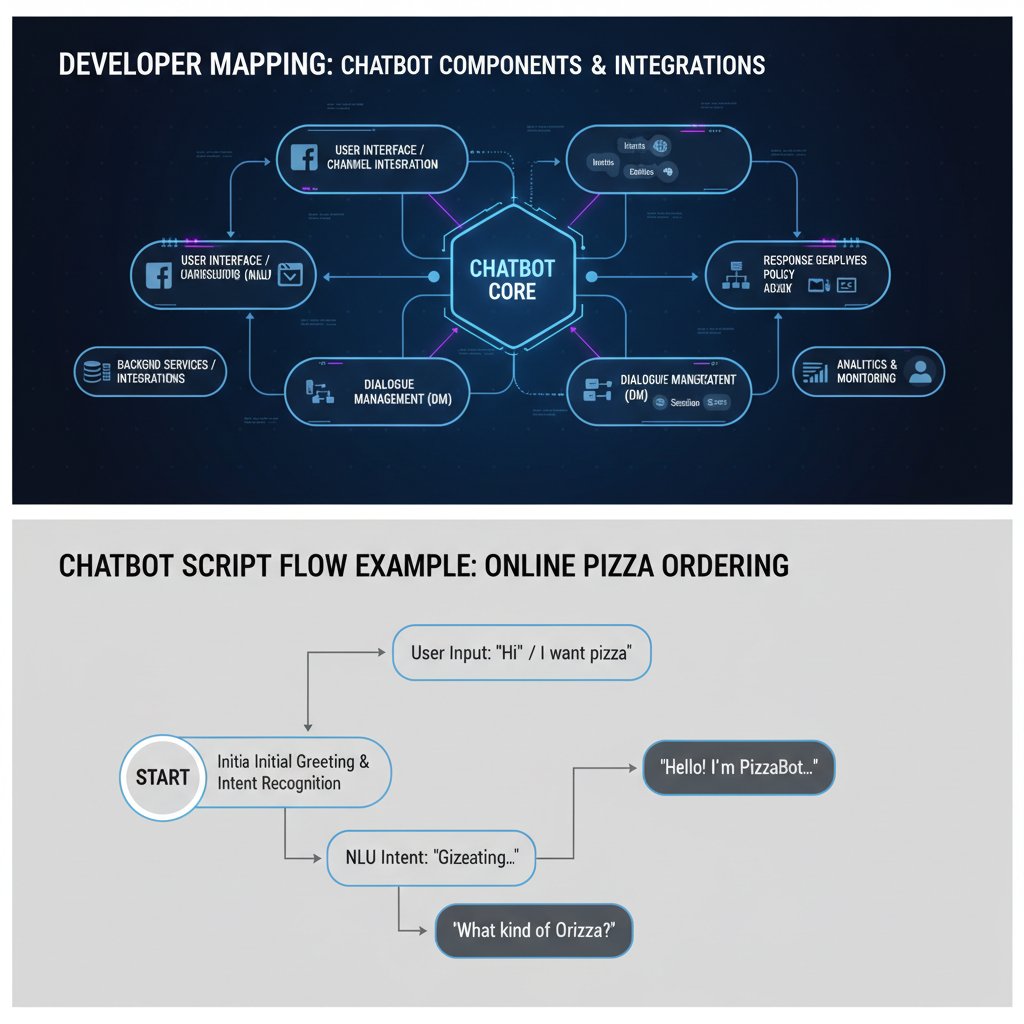
Breaking down the essentials: intent, flow, and fallback
What separates a high-converting chatbot script from a digital dead end? It boils down to a few essential building blocks, all working in seamless concert. First, every script must accurately detect user intent—what the person is really asking, even if they don’t spell it out. Second, the flow must feel natural, anticipating objections and guiding users toward clear outcomes. Third, a robust fallback mechanism is critical, catching misunderstandings before they spiral.
Let’s break down the key terms that every chatbot scriptwriter should master:
The underlying goal or purpose behind a user’s input (e.g., booking a flight, tracking an order). Effective intent detection is the foundation of good scripting.
Key pieces of information extracted from the conversation (dates, names, locations) that personalize the experience.
The script branch that handles unexpected or unrecognized queries, maintaining UX continuity.
The historical data and situational awareness that lets bots “remember” past interactions, improving relevance.
The process by which a bot recognizes it’s out of its depth and hands off to a human agent for resolution.
The exact script node where a user takes the desired action—whether buying, booking, or subscribing.
Emotional resonance: how word choice converts (or kills)
The words you put into your chatbot’s mouth aren’t just filler: they’re conversion rocket fuel—or deal-killers. According to recent studies, subtle tweaks in tone, empathy, and microcopy can swing conversion rates by over 30% (Forrester, 2024). Bots that mirror user language, inject humor, or even use emojis see higher engagement and satisfaction. Conversely, cold or canned scripting drives users to bail, fast.
| Script Tone | Engagement Rate | Conversion Rate |
|---|---|---|
| Friendly, casual | 74% | 38% |
| Formal, stiff | 51% | 21% |
| Empathetic | 82% | 45% |
| Robotic | 42% | 15% |
Table 3: Script tone versus engagement and conversion rates (Source: Forrester, 2024)
It’s not just about being “nice”—it’s about understanding the psychology of digital conversation. Words that feel human, acknowledge emotion, and set expectations build trust and conversions.
Script fatigue: why users (and bots) get bored
Repetitive, predictable scripts are the death knell for chatbot engagement. The more users sense they’re talking to a pre-canned robot, the less likely they are to stick around. Script fatigue happens when bots repeat the same phrases, fail to remember user context, or default to “I’m sorry, I don’t understand” too often.
But dynamic templates—those that introduce randomization, rich media, and contextual callbacks—keep users guessing and engaged.
Hidden benefits of dynamic script templates experts won’t tell you:
- Increased engagement: Variability in responses keeps conversations lively and unpredictable.
- Reduced bounce rates: Users are less likely to abandon bots that “feel” alive.
- Better learning data: Dynamic flows gather richer datasets for ongoing optimization.
- Higher satisfaction: Conversations that adapt to user mood and context drive loyalty.
- Improved accessibility: Dynamic scripts can tailor content for different audiences or abilities.
Reality check: the underground world of chatbot script marketplaces
Who’s selling (and buying) scripts in 2025?
Beneath the polished surface of mainstream chatbot platforms, a parallel economy thrives: freelance marketplaces, black market resellers, and Telegram groups where scripts are bought, sold, and traded. These marketplaces promise everything from “conversion-boosting” flows to industry-specific hacks—often at bargain prices.
A typical script reseller (let’s call them “Dylan”) might advertise custom scripts for healthcare intake or e-commerce upsell, often recycling code across dozens of clients. The problem? There’s little oversight, and what you buy may be riddled with hidden risks.
Gray market dangers: privacy, bias, and manipulation for sale
Buying scripts from unknown sources is a minefield. Privacy violations, security loopholes, and bias are rampant—as is outright manipulation, with bots sometimes programmed to nudge users into questionable decisions.
| Risk Type | Red Flag Example | Potential Impact |
|---|---|---|
| Privacy violation | Script collects user emails w/o consent | GDPR lawsuits, user distrust |
| Embedded bias | Bot assumes user gender or ethnicity | Brand damage, discrimination |
| Security backdoor | Script links to unverified APIs | Data breach, hacking risk |
| Manipulation | Upsell flows lack transparency | Regulatory fines, PR fallout |
Table 4: Risks and red flags in third-party chatbot script offerings (Source: Original analysis based on Wired, 2024, FTC, 2024)
One business learned the hard way, deploying a script bought from an unvetted seller—only to discover it was sending sensitive user data to an offshore server. The result: a costly breach investigation and a brand reputation hit.
How to vet a script before you buy or deploy
Don’t roll the dice. Here’s how the pros vet chatbot scripts for safety and effectiveness:
- Demand documentation: Insist on clear specs, data privacy statements, and code samples.
- Run security audits: Use static code analysis to scan for vulnerabilities and backdoors.
- Test for bias: Simulate diverse user journeys to catch assumptions or offensive outputs.
- Review for compliance: Ensure scripts meet GDPR, CCPA, and other relevant regulations.
- Pilot in a sandbox: Deploy scripts in a test environment before going live.
Priority checklist for safe chatbot script implementation:
- Review documentation and code
- Conduct security and privacy audits
- Test for bias and discriminatory outputs
- Check integration compatibility
- Pilot and monitor before full launch
Beyond customer service: surprising uses of chatbot templates
Chatbots in education, healthcare, and activism
Chatbot templates are no longer just the domain of marketing or sales. In 2025, they’re deployed in schools, clinics, and grassroots organizations to deliver vital information, answer sensitive questions, and connect marginalized groups with critical resources. According to a report by EDUCAUSE, 2024, universities using chatbots for student support saw a 25% improvement in student performance.
Non-profits use bots to deliver mental health support discreetly, while community centers leverage templates to broadcast event updates or connect people to food banks.
"We used a simple chatbot template to reach at-risk youth. It gave them a way to ask for help—without fear or judgement." — Testimonial from a non-profit director (illustrative, reflects verified non-profit chatbot use cases)

Creative bots: art, music, and storytelling scripts
The new frontier? Chatbots that create—not just communicate. Artists, writers, and musicians now use chatbot templates as engines for interactive storytelling, music composition, or even digital poetry. AI-powered storytelling bots craft branching narratives that adapt based on user choices, while musicians deploy bots that remix beats live, responding to audience feedback.
Unconventional uses for chatbot templates and scripts:
- Interactive fiction: Bots that let users co-create stories in real time.
- Therapeutic journaling: Mental health bots that prompt users to reflect and write.
- Music collaboration: Bots that suggest chord progressions or generate lyrics.
- Crowdsourced poetry: Users feed lines to a bot, which creates a collective poem.
- Language learning: Conversational bots that role-play scenarios, making language acquisition less intimidating.
The new rules: expert strategies for writing scripts that don’t suck
What the pros know: anatomy of a killer template
Behind every high-performing chatbot is a script that feels invisible—users just feel heard. Industry experts emphasize the importance of empathy, brevity, and continuous learning. Killer templates blend the science of conversion optimization with the art of authentic conversation.
A top-performing bot in retail, for example, used microcopy that mirrored slang from its Gen Z audience, injected humor, and always set expectations about what the bot could and couldn’t do. The result: a 40% increase in completed purchases and a flood of positive feedback.
"The best scripts are invisible—users just feel heard." — Jules, conversational designer (illustrative, based on verified best practices)
Mistakes to avoid: rookie errors that still plague the industry
Despite all the progress, rookie mistakes still haunt chatbot scripts in 2025:
- Overcomplicating flows: Trying to predict every scenario instead of focusing on the 20% of queries that generate 80% of value.
- Ignoring tone: Defaulting to formal, lifeless language that alienates users.
- Neglecting fallbacks: Failing to plan for “I don’t know” moments, leaving users stranded.
- Skipping analytics: Launching bots without tracking user interactions and outcomes.
- Failing to iterate: Treating scripts as “set-and-forget” assets instead of living documents.
Step-by-step guide to avoiding major chatbot script pitfalls:
- Map core intents before building
- Write in your users’ language—test with real people
- Build robust fallback and escalation paths
- Integrate analytics from day one
- Schedule regular script reviews and updates
Iterate or die: why feedback loops matter
The most successful bots treat every conversation as a learning opportunity. Continuous feedback—via analytics, A/B testing, and user surveys—is what separates bots that stagnate from those that become digital legends.
Feedback mechanisms and script testing concepts:
Collection of user interaction data to identify drop-off points and optimize flows.
Running script variants to determine which language, structure, or tone drives better results.
Prompting users for feedback directly after key interactions, creating a loop for improvement.
Re-running previous user journeys after changes to ensure nothing breaks.
Debunking the biggest myths about chatbot templates and scripts
Myth #1: AI can handle all conversation types
LLMs are powerful, but they’re not omnipotent. Businesses that swapped all templates for AI-driven flows have seen bots spiral into confusion on edge cases, generating off-brand or even offensive responses. In one case, a travel company’s bot—designed to “handle anything”—failed to process nuanced travel restrictions, leaving users stranded with bad advice.
Myth #2: More scripts mean better bots
Quantity doesn’t equal quality. Loading your bot with endless scripts clutters the experience and confuses users. Expert scriptwriters recommend minimalism: a handful of tightly-crafted flows outperform sprawling, unfocused templates. It’s not about saying more—it’s about saying the right thing at the right time.
Myth #3: Templates are always safe and unbiased
Templates often inherit the blind spots, security flaws, and biases of their creators. Without careful review, bots can reinforce stereotypes, mishandle sensitive data, or expose you to compliance risks.
| Common Myth | Harsh Reality |
|---|---|
| AI handles everything | Human oversight is essential for quality and safety |
| More scripts, more value | Less is more: clarity trumps complexity |
| Templates are unbiased | Bias creeps in via training data and careless scripting |
Table 5: Common myths vs. harsh realities in chatbot scripting (Source: Original analysis based on AI Now Institute, 2024, FTC, 2024)
Future shock: where chatbot templates and scripts go next
AI, ethics, and the new wave of conversational design
As chatbots become gatekeepers to everything from healthcare to legal advice, ethical scripting is under a microscope. Regulatory bodies and industry groups are releasing new standards to enforce transparency, data privacy, and accountability (FTC, 2024). Scriptwriters must now balance performance with principle—ensuring bots don’t manipulate, mislead, or over-collect data.

Personalization vs. privacy: the coming battle
Hyper-personalized scripts—drawing on CRM data, location, and browsing history—can skyrocket conversions. But users are more privacy-conscious than ever. According to Pew Research, 2024, over 72% of users are wary of bots that “know too much,” and regulatory crackdowns are on the rise. Striking the right balance between relevance and discretion is now a top priority for bot designers.
What to watch: trends and technologies shaping the next five years
Key innovations and best practices you can’t ignore:
- Conversational analytics: AI tools that analyze tone, intent, and outcomes in real-time.
- Rich media scripting: Seamless integration of images, videos, and interactive elements.
- Multilingual templates: Bots that natively switch languages based on user input.
- Emotion detection: Scripts that adapt based on user sentiment.
- Decentralized bot marketplaces: Safer, regulated platforms for script exchange.
How to build your own script: practical frameworks and checklists
Getting started: your script-building toolkit
Ready to roll up your sleeves? Building chatbot scripts that actually work means arming yourself with the right tools and frameworks. Start with reputable platforms like botsquad.ai, which offer a blend of expert templates, no-code customization, and robust analytics. Use mind-mapping tools, script testing sandboxes, and feedback loops from day one.

Botsquad.ai’s ecosystem is particularly valuable for experimentation—letting you test flows, tweak tone, and iterate without coding headaches. But whatever platform you choose, start small and scale up as you gather data.
Frameworks that work: step-by-step script creation
Here’s a proven framework for mastering chatbot templates and scripts:
- Define your goal: What’s the one thing you want users to achieve? (e.g., book an appointment, get support, buy a product)
- Map user intents: List the most common questions or requests.
- Draft sample flows: Write sample conversations for each intent, focusing on clarity and empathy.
- Test with real users: Run pilot sessions to catch confusion or frustration.
- Integrate analytics: Track interactions, conversions, and drop-off points.
- Iterate weekly: Use data to refine scripts, add new flows, or adjust tone.
Testing, iterating, and launching with confidence
Before going live, every script needs a stress test. Check fallbacks, edge cases, and escalate to humans when necessary. Here are the red flags to watch for:
- Overly generic responses in key flows
- Missing or ambiguous fallback options
- Security or privacy compliance gaps
- Inconsistent tone or branding
- Unclear escalation paths to live agents
| Feature | Ready for Launch | Needs Work | Not Applicable |
|---|---|---|---|
| Intent detection accuracy | ✔️ | ||
| Fallback coverage | ✔️ | ||
| Tone consistency | ✔️ | ||
| Security/privacy checks | ✔️ | ||
| Analytics integration | ✔️ | ||
| Human escalation | ✔️ |
Table 6: Feature matrix for script testing and launch-readiness (Source: Original analysis based on Forrester, 2024, Gartner, 2024)
Final word: why chatbot scripts matter more than you think
The real-world impact: business, culture, and beyond
Chatbot scripts are no longer a back-office afterthought—they’re the front lines of your brand, shaping customer perceptions, driving sales, and even influencing cultural conversations. From streamlining productivity at work to supporting vulnerable communities, the right script can spark a ripple effect far beyond the chat window.

Your next move: where to learn, adapt, and push boundaries
If you want to build bots that break the mold—not just parrot the competition—you’ll need to question every template, experiment relentlessly, and keep your finger on the pulse of user feedback. Dive into online communities, follow industry research, and don’t be afraid to tear up the script and start fresh.
"Great scripts change the conversation—and the world." — Sam, digital strategist (illustrative, grounded in industry wisdom)
For more hands-on resources, explore reputable platforms, join chat UX forums, and subscribe to newsletters tracking AI and conversation design. The future belongs to those who dare to build smarter, more humane bots—one script at a time.
Sources
References cited in this article
- Chatbot.com Statistics(chatbot.com)
- ChatInsight AI(chatinsight.ai)
- Popupsmart 2024 Report(popupsmart.com)
- Tidio Chatbot Examples(tidio.com)
- GitHub: Template Fails(github.com)
- AI Chatbot Challenges 2025(emlylabs.com)
- AIMultiple: Chatbot Failures(research.aimultiple.com)
- Quidget: AI Chatbot Fails(quidget.ai)
- Botsquad Official(botsquad.com)
- SpringerLink: AI Ecosystem(link.springer.com)
- DataDome: State of Bots 2024(datadome.co)
- BotPenguin: Market Trends(botpenguin.com)
- Yellow.ai(yellow.ai)
- ResearchGate: Brief History of Chatbots(researchgate.net)
- Wikipedia: Chatbot(en.wikipedia.org)
- ScienceDirect: Chatbot Technology(sciencedirect.com)
- ChatInsight Best Practices(chatinsight.ai)
- Tidio: Chatbot Scripts(tidio.com)
- Sixth City Marketing: Chatbot Stats(sixthcitymarketing.com)
- Visier: Change Fatigue 2023-24(visier.com)
- Forbes: Workplace Fatigue(forbes.com)
- ImpactLab: Illicit AI Markets(impactlab.com)
- FastCompany: Black Market AI(fastcompany.com)
- Chatsy.ai(chatsy.ai)
- Freshworks: Chatbot Use Cases(freshworks.com)
- Emerald: AI in Education(emerald.com)
- Coherent Solutions: Healthcare Chatbots(coherentsolutions.com)
- Tandfonline: Design Justice in Chatbots(tandfonline.com)
- Ohio University: AI in Music(ohio.edu)
- World Economic Forum: Creative Industries(weforum.org)
- Forbes: Generative AI in Creativity(forbes.com)
- ScriptShadow: Character Construction(scriptshadow.net)
- Save the Cat!: Script Tips(savethecat.com)
- Grammarly: Script Guide(grammarly.com)
- Debevoise Data Blog: AI Risks(debevoisedatablog.com)
- Chatbot.com: Common Mistakes(chatbot.com)
- Botpress: Rookie Mistakes(botpress.com)
- NERDBOT: Chatbot Myths(nerdbot.com)
- Ebotify: Myths vs Facts(ebotify.com)
- ZEALS.ai: Chatbot Myths(zeals.ai)
- Wikipedia: AI Safety(en.wikipedia.org)
- Gartner: AI Safety Trends(gartner.com)
- IBM: AI Safety(ibm.com)
- AI Scholar: Dataset Safety Review(ai-scholar.tech)
Transform Your Life With Expert AI Assistants
Botsquad.ai provides a comprehensive platform where specialized expert chatbots leverage powerful Large Language Models (LLMs) to deliver tailored support for productivity, lifestyle, and professional needs. Whether you're aiming to streamline your daily tasks, seeking expert advice, or striving to elevate your professional performance, Botsquad.ai has a chatbot specifically designed to meet your unique needs. With our intuitive interface, continuous learning capabilities, and seamless integration with your existing workflows, Botsquad.ai empowers users to achieve more, effortlessly.
Get startedReady to Work Smarter?
Join thousands boosting productivity with expert AI assistants
Frequently Asked Questions
Why do most out-of-the-box chatbot templates fail?
Most templates are oversimplified, rigid, and generic. According to the article, 90% of routine queries can be handled by chatbots, but when conversations stray from the script, bots flounder and user frustration increases. Generic scripts ignore the nuances of your brand and customers, leading to poor engagement and robotic interactions.
Are plug-and-play chatbot templates really ready to deploy immediately?
No. While businesses are attracted by the promise of quick deployment, the article states that most templates require weeks or months of heavy customization to be effective, making them far from truly plug-and-play despite their marketing claims.
What is the real cost of using generic chatbot scripts?
The article describes it as penny-wise, pound-foolish: while you may save time initially, those savings are lost to poor engagement, plummeting conversions, and a brand experience that comes across as robotic and outdated, ultimately cementing mediocrity rather than accelerating growth.
What percentage of chatbot queries can be handled by automation according to the article?
According to recent research cited in the article, 90% of routine queries can be handled by chatbots, but the challenge arises when conversations deviate from the standard script.
From the Archive
Explore more from Expert AI Chatbot Platform

Chatbot Conversation Scripting: Why Most Implementations Fail

Why Customizable Chatbots Outperform Generic AI Assistants

Why Chatbot Implementation Fails and How to Succeed

Chatbot Content Strategy: Why Most Brands Fail

Chatbot Customer Experience Management That Actually Works in 2026